001: Starting with Kanji
Before I get into the specifics, I want to emphasize the importance of the translator in works like these—for the initial nine volumes of Genshiken, that title belongs to David Ury, who may be known better as Spooge from Breaking Bad and Better Caul Saul, or as the writer and co-director of “What kind of Asian are you?” Before getting his head smashed on TV or making YouTube videos, he was tasked with translating Genshiken into English, and I think he did an amazing job considering the time. When I first read Genshiken (which was through the English translation), I found so much of the dialogue to be incredibly naturally translated (which tends to be an issue in very otaku-centric series, where awkward and overly-literal translations made by fans tend to dominate the spaces). Where the translation sometimes falls flat would be the references, which sometimes get a bit mistranslated. However, considering that I’m able to look back on this with 20 years of fandom culture growth, I can’t fault him for these errors—that would’ve required him to know a deep history of Japanese media and fandom in addition to how all of that culture had been translated and brought to America—if it had even came out over here in the first place!
Without further ado, let us delve into the very first chapter of Genshiken.
…
Actually, I want to start with something that technically comes before the first chapter—sorry for getting you all excited for nothing. While I don’t have all English releases of Genshiken to confirm this for the series, I assume that American publications of manga have generally stuck to the same practice of exclusively printing the books in black and white. Avid manga readers may notice that the first few pages of some books occasionally have a bit of a different look to them—instead of the high-contrast black-on-white style usually seen in the rest of the book, it may have a smoother, perhaps painterly style of shading (with far more noticeable amounts of gray). This is because they are reproductions of pages that originally did have full coloring—though I don’t think I’ve seen American releases ever preserve this. So, the first few pages of this have some nice colors that you may be unfamiliar with. It’s nothing out of the ordinary, but I figured it should be mentioned anyways (personally, I find the lavender shade of the title above the drawing of Kasukabe sitting on the TV to be quite pleasant).
Okay, now let’s get to the chapter itself. The first point of interest is actually the chapter title itself, which showcases an interesting issue with translating from Japanese to English. In English, the two ways to refer to the titular club are either the full “Society for the Study of Modern Visual Culture,” or the shortened “Genshiken.” This is admittedly a little confusing, because we jump the language gap in between those two names—the original full name is “gendai shikaku bunka kenkyūkai” (word by word, that’s “[modern (era)] [vision/visual] [culture] [research society]”). That said, the English version of the name also originates from the original Japanese text, so that’s why you always see it translated as “the Society for the Study of Modern Visual Culture” without any variation.
The issue at hand arises with the fact that they don’t really say “Gendai Shikaku Bunka Kenkyūkai” or “Genshiken” in Japanese; they say “現代視覚文化研究会” and “現視研”… and “げんしけん.” You might notice that two terms have become three—and that’s because both of the latter two are “Genshiken.” The difference between these two is actually brought up in the series, but I figure it’s good to walk through the whole explanation for anyone who forgot or missed it.
The Japanese language uses kanji—written characters originally from China that have inherent meaning—in addition to kana, their own original symbols that function like the English alphabet, wherein each character just represents a piece that can be used to form full words. In this way, someone can read “現視研” (“Genshiken” written in kanji) and still probably understand that it’s related to the study of something that you can see in the present day. Alternatively, they may read “げんしけん” (“Genshiken” written in kana), which has as much inherent meaning as “Genshiken” does in English—that is to say, you’re probably not gonna know what it means unless you’ve heard about it before.
So, there are three levels of labels for the titular club: the full title, the abbreviated title, and unclear (phonetically) abbreviated title.
I think this concept might be illustrated well in English by a story from my past. When I was in university, I heard about a really interesting department; in spoken conversation, I thought someone told me that they were “majoring in havoc.” Wow—that sounds cool! Are they minoring in destruction too, or perhaps disarray? It turns out that what they actually said was “HAVC,” which is still pretty vague as far as meaning goes (but at least it’s clear it’s an abbreviation). I doubt anyone would be able to guess what it means from the acronym alone, but it might help if it’s upgraded to an abbreviated form: HIST. ART VIS. CULT. (I don’t think the program has ever used this abbreviation, though). Even though most of those aren’t full words, I’m now guessing that you might be able to discern what that department was called. If you were able to guess “History of Art and Visual Culture”… then hopefully you get my point! (And hopefully you also weren’t too bored by the little recount of my past—hey, what the hell, isn’t this article supposed to be about Genshiken?)
So, why did I spend all of that time explaining stuff that isn’t nearly as fun as the pop culture elements in the comic we all wanted to read about? It’s because the first chapter’s original Japanese title is “現視研” (“Genshiken” in kanji), and the translated title of “Genshiken” feels more like the unclear (kana) “げんしけん” to me. What’s my solution? I’m tempted to give the club name a potential (English-language) middle ground with something like “Soc.Vis.Cult.” as an abbreviation, but something still comprehensible in English.
…Of course, in the binary of “Society for the Study of Modern Visual Culture” versus “Genshiken,” I understand why the first chapter gets simply translated to “Genshiken.” It’s so iconic that even I wouldn’t really want to touch it!
Now—after much ado—let’s finally get into the meat of the story!
…Kind of. This first chapter is heavy with lots of background elements that flesh out the university rather than provide otaku-level references for readers’ enjoyment (not to say that these other details can’t be fun for readers). If you want to skip most of the university stuff, you can go right down to around page 14.
PAGE 3
Whoops—almost missed this one! (This section was written after the write-up for the next page below.) Ury translates a couple of lines of random text on this splash page, but he missed the one right next to the doorknob (guess I can’t blame him, since I also skipped over it at first). It says “女性問題研究会” (josei mondai kenkyūkai), so that’d be the “Women’s Rights Club,” and it says they meet in room 203.
PAGE 4
A few signs at this big club fair scene were skipped, likely due to either redundancy or difficulty with translating them. For example, the Yakiniku Club in the back on the left has a big sign that just repeats “YAKINIKU” (they’ve got the right idea—advertising food will definitely get them traffic).
The other sign that was left untranslated on this first panel is a bit more difficult to explain. It hinges on what was given by Ury as the “Civil Rights Action Network,” which I might personally translate as “the Society for Human Rights” (both are better than the overly literal “Human Rights Issue Research Society”). This untranslated sign reads “ゴネ得と人権” (gonedoku to jinken). The latter half of this is “human rights” (which is what connects it to the Civil Rights Action Network), though the former part is what may create some confusion; it’s a term that means “getting what you want by complaining”—it seems to have as much of a negative connotation as it sounds like it’d have. I imagine it might be the club being a bit sly with what they do (or perhaps Kio making a statement), but I think a good way to translate it would be “Squeaky Wheels and Human Rights.”
PAGE 5
Behind the guy trying to get Sasahara to learn mahjong is assumedly a sign for the club he’s a part of—we can only make out part of it, but it seems like it’s at least called the “テーブル研究会” (tēburu kenkyūkai), which would make it the “Table Club.” Tabletop games (including mahjong) are referred to as “テーブルゲーム” (tēburu gēmu) or “table games” in Japanese, so it very well may be that the last part of the word is cut off and this could likely be the “Tabletop Club” if we adapt it to English.
PAGE 6
This is a real crazy one. I remember when I first read Genshiken and was really curious what the story was behind the mysterious “…nya Studies Club.” There’s clearly more than just “nya” visible in the original Japanese, but the only possible option… well, it just seems absurd. The original text is “…ルキゲニア研究会” (…rukigenia kenkyūkai), and the only term that matches the first word there is… “Hallucigenia.”
Do you know about Hallucigenia? I wouldn’t blame you for not knowing. Have you ever known someone who seems weirdly ride-or-die about Anomalocaris? I can only imagine that Kio may have known someone like that (or perhaps he was that way himself). This “Hallucigenia Research Club” has a smaller sign underneath still visible in the English translation that seems to read “有り” (ari) and “熱” (netsu), though I can’t tell if these are partially covered or not—the best I can make sense of these fragments are that the club focuses on if Hallugenia really exist or not, and that they’re currently all the rage.
PAGE 7
The Astronomy Club’s main sign is given labeling, but not the sign it has in the background—it says “春の星座会” (haru no seizakai), which I’d translate as “Spring Constellation Meet.”
The official English translation just erases everything on the next sign and replaces it with “PHOTOGRAPHY CLUB,” though there’s actually a bit more to it in the original—it has both “紳士の社交場” (shinshi no shakōjō) and “写真部” (shashinbu). While the latter could be “Photography Club,” I always personally understand that -bu ending to be “department” first and foremost, and I think this school having a “Photography Department” is pretty reasonable. This is especially true when there’s a more club-like group described in the other part of this sign; the overly literal meaning of shinshi no shakōjō is “[gentleman][’s] [social life] [place],” which conveniently exists almost directly in English with the term “gentlemen’s club.” I was a little concerned about my own usage of the term, since it also prominently exists as a euphemistic term for strip clubs, but it turns out that shinshi no shakōjō may also have a euphemistic definition (if you look it up the term on Pixiv, there’s a whole lot of porn… but maybe that’s more of a Pixiv thing than a shinshi no shakōjō thing). So, for Genshiken, it may be more accurate to say that the photography department is running a “gentlemen’s club,” rather than there simply being a big sign for the Photography Club.
PAGE 8
I just thought this was an interesting note—the original text (which can be seen in the English version) “ぱくぱく” (paku paku) might ring a bell to people who like learning fun facts about old video games. The paku paku onomatopoeia is what inspired Pac-Man’s name, and can refer to munching like a madman. Of course, that’s not what Sasahara is doing here—he’s certainly flapping his mouth open and closed, but I assume it’s supposed to be interpreted as him hemming and hawing… which I think Ury did a good job with him hesitating on his words and saying “um— um—” in the English translation. Through the Pac-Man angle, though, I find it entertaining to imagine someone translating it as “waka waka.”
PAGE 9
This has a couple of interesting clubs that go untranslated—if only because they’re both partially obscured. The panel of Sasahara walking by Kasukabe gives us “コス[?]研[?]” (kosu[?]ken[?]) and the even more partial “[?吾]会” ([go?]kai).
While I can’t be sure, it seems that the former of these two clubs is something that would go on to get subtly retconned out. The most likely explanation for a club focusing on something beginning with “kosu” would be the コスプレ研究会 (kosupure kenkyūkai): the Cosplay Club. The established existence of such a club seems to clash with parts of the series later on, so maybe it’s good that English readers never caught onto this.
The next one is a bit more complicated to explain. I transcribed the sign as “[?吾]会” which might be a little confusing—that [?吾] represents a partial character. We can tell what the right side of it looks like (because it’s right at the edge of the page), but that doesn’t exactly narrow it down, since it could be 悟, 唔, 梧, 珸, 牾, 晤, 語, or 齬, which can all be read as “go” (that’s something that comes with having the right side be 吾). All things considered, I believe it’s probably “語,” which would mean it’s some sort of language meetup—since English is just about the most emphasized foreign language in Japan, I’d personally assume that it’s “英語会” (eigokai) and translate that as “English Language Meetup.”
(Fun fact: the first of those symbols that can all be read as “go” is actually the first part of Goku’s name: 悟空 (Gokū). Perhaps readers with photographic memory who watch Dragon Ball may have caught onto this, as one of the outfits that Goku wears displays a “悟” on the chest—and yes, that means he’s even more like Superman than you may have previously thought.)
PAGE 10
I might skip over some things like this in the future, but I figured people might be really curious over every little thing right at the start of the series—the little sign above the display for the Manga Club on the right side simply says “これは慢研” (kore wa manken), or—to render that in English—“this is the Manga Club.”
PAGE 11
This page is gonna be a doozy.
First, I wanted to mention a couple of things about the first two panels—Ury cleaned up the language and made it much more presentable and comprehensible in English, but I know that weeaboos love foreignization (they would call it “accuracy,” though)—so let’s get less comprehensible.
First, the label for the “Guide to School Clubs” is a bit longer in the original Japanese… and frankly, I can’t make out the smaller text above it that was cut from the English version (dang, maybe I should’ve tried getting one of those slightly larger reprints of the Japanese Genshiken…). Ultimately, it’s filler text—not necessary for the story—but my best attempt at reading it is “椎応学校” (Shiiō gakkō), which can be translated to “Shio campus” (which doesn’t technically make sense, as it should be “Shio University,” or maybe some other name referring to this campus specifically), and tying that with a more direct translation of the rest of the text, “サークル入会の手引き” (sākuru nyūkai no tebiki), gives us “Shio Campus Club Entry Guidebook.” I think Ury’s translation works much more clearly.
Second (skip this one if you don’t care to learn about Japanese language facts), Sasahara’s “let’s see… page 23…” in the English translation was originally a bit more specific. As big-time fans of Japanese media may have noticed by now, Japanese is a pretty different language from English—this extends to how its writing system is formatted, of course. While English has alphabetical order for sorting text, Japanese has a system called Gojūon (五十音). Since Japanese is essentially based on syllables, the fastest way to explain it is that it basically sorts by the starting sound of the first syllable, and then it sorts each of those sections by that syllable’s ending vowel sound (there are a couple of caveats to that, but I won’t get into them—go read the Wikipedia article if you’re that curious). Sasahara’s original dialogue specifies that he starts by finding the section for words beginning with “K,” locates the “ke” section, and then he heads to page 23… which might be a little confusing since “Genshiken” starts with a “G” in English. This is because a few different sounds in Japanese are actually rendered as modifications of another—one such case is that the “G” sounds are written by adding a little diacritic to the “K” sounds. You can see this by comparing the symbols け (ke) and げ (ge)—the only difference is that they just put in that little ゛ at the top right. I’ve always thought of this kind of like an instant Spurdo Spärde switch. oh fug xDDDDD
Next, we get to the long list of clubs, which I will use now to bring up another element of Ury’s translations. Most of the student organizations—both from this page and earlier—use the term 研究会 (kenkyūkai), which explicitly involves the concept of “research” or “study” in it (it’s the kenkyū part, specifically). That’s why it’s called “the Society for the Study of Modern Visual Culture”—though I don’t think that term works too well for every single kenkyūkai here. For example, the Yakiniku Club is actually the Yakiniku Kenkyūkai, and I think most people would reject the translation “the Society for the Study of Yakiniku.” To domesticate that title a bit further into English, think about it as “the Barbecue Research Society”—that sounds a little crazy, right? Truth be told, I’m not sure what exactly the Yakiniku Kenkyūkai does (maybe they really do diligently research their subject), but Ury probably made the right call translating most of these student organizations into simple “clubs.” My understanding of the term “kenkyūkai” is that it’s not to be taken literally—it’s just a somewhat fanciful term for what we would call in English a “club” more often than not. Speaking of, let’s get into my notes about that list of clubs:
“Humanities Club” is a much more normal-sounding translation for the “人類文化研究会” (jinrui bunka kenkyūkai), or “the Society for the Study of Human Culture,” though I personally feel like it may be a bit too general (probably because “humanities” encompasses everything that’s not considered a science).
“Multi Cultural Studies Club” makes sense in English (aside from the space in “multicultural”), but it feels to be a bit different from the original “比較文化研究会” (hikaku bunka kenkyūkai), which two separate real-life groups help show us that it might be more accurate to say “the Society for the Study of Comparative Culture.” I guess the concept of multicultural studies does mean you’ll be comparing those different cultures to each other, though… so Ury probably made the right choice, since I’ve never heard of the term “comparative culture” in English before (but it does seem to exist).
Here’s the real big one—fans of both the Genshiken manga and anime may have already caught onto this. In the Genshiken’s space in the guidebook, there was originally text next to the anime girl drawing (Tachibana Izumi from Genshiken’s own Kujibiki Unbalance, for anyone curious). This read “ココニイル。” (koko ni iru.)—this is a very stand-out way to write “WE ARE HERE.” I have no idea why it didn’t get a translation put in its place (if I had to theorize, maybe a typesetter messed up and forgot the line), but it almost feels more intense with just the picture of Izumi. Hm… I wonder where that image came from in canon—did Kugayama draw it?
“Pacific Studies Club” is another case where I can see why Ury simplified it a bit, because the original “環太平洋文化同好会” (kantaiheiyō bunka dōkōkai) is a bit strange in English. This club focuses on “Pacific Rim culture,” or probably more likely “cultures from the Pacific Rim.” One may also note that this is not a kenkyūkai but rather a dōkōkai, which is a less intense-sounding term that literally means “[same] [preference] [group].” So, these people admit that their club isn’t doing anything crazy—they just like this stuff. I’d maybe render this as the “Pacific Rim Cultural Club,” then. And for the record—this isn’t a club for the movie called Pacific Rim (it wouldn’t even be out for about another decade).
Sigh… maybe I’m getting too nitpicky about these notes. “アフリカ会社研究会” (Afurika kaisha kenkyūkai) stands out to me because its English translation, “African Culture Club,” seems to fit with many of these other culture clubs, but the original term is different; those ones are “文化” (bunka), but this one is “会社” (kaisha)—normally this term means “society.” So, this is maybe more of an “African Society Club”… but that sure sounds like it could also be an “African Culture Club” to me.
“East Meets West Culture Club” is a bit clunky to me, but it gets the point across. The focus for this kenkyūkai is specifically “東西文化交流” (tōzai bunka kōryū), or “East-West Cultural Exchange.”
Here’s a pretty big change—Ury’s “Ocean Lover’s Club” was originally the “海洋文化研究会” (kaiyō bunka kenkyūkai). This one was giving me a bit of trouble, since—while each piece of the puzzle makes sense—I wasn’t sure how to put them together. Piece by piece, it’s “[ocean] [culture] [research society],” but I wasn’t sure if that would mean “maritime culture” or “marine culture.” I eventually found the 加古川海洋文化センター (Kakogawa kaiyō bunka sentā), which thankfully provides the English name “Kakogawa Marine Culture Center.” Thus, I’m content with calling this “the Society for the Study of Marine Culture” (maybe it’s just a reaction to the incredibly casual sound of “Ocean Lover’s Club,” but it only feels fair to give them a bit more of a professional-sounding title).
What Ury renders as the “Classic Japanese Club” is actually a bit more broad, being the a kenkyūkai focused on “古代文明” (kodai bunmei), or “ancient civilization.” I’m assuming it’s not just a single one (perhaps this is what Ury did, which is how it ended up being Japan-centric), so I might consider this the “Ancient Cultures Research Society,” myself.
…Though speaking of the study of historical Japanese culture, Ury got “Heian Period Studies Club” pretty much on the nose. It does mention specifically that it’s Heian culture—“平安文化” (Heian bunka)—in the original, but I think what he did is fine.
This is a bit of a weird one. “Medieval History Club” makes way more sense than the original “中性比較研究会” (chūsei hikaku kenkyūkai), which readers who have been memorizing every single Japanese word so far might notice has the same hikaku as “the Society for the Study of Comparative Culture” did. “Chūsei” is definitely medieval, so what exactly are they comparing here? I’m not sure, but we end up with “the Society of Medieval Comparative Studies” (maybe this is one that Kio was goofing around with).
The last one in this list is about as straightforward as it gets—it’s a kenkyūkai for “シルクロード” (shiruku rōdo), which is a transliteration of the English “Silk Road.” Thus, “Silk Road Studies Club” is probably even more on-the-nose than “Heian Period Studies Club.”
Alright, that wraps up the guidebook. But… sigh… we’re not quite done with this page.
I’m gonna take this brief interlude to give credit to one of the most useful resources I had with this section: this partially-written compilation of all of the different student organizations present in Genshiken has been super useful as I’ve been tackling this article. I got through that first page of the crowded club fair by myself, but I was getting real sick of trying to transcribe all of the really tiny text on page 11—then, I was luckily able to find this list. It also confirmed my suspicions about the Hallucigenia Research Club (and it just now made me realize I missed the Women’s Rights Club all the way back on page 3… so I just went back and wrote that part in), so I can’t give this page enough credit for helping out with this initial chapter.
Okay, back to the grind.
Behind Sasahara as he checks the guidebook one last time lies two more club names—they were both erased in the English release, but only one had a new name inserted in. This new name, “Gardening Club,” is a far cry from the original “楼蘭研究会” (Rōran kenkyūkai), though I don’t blame him much for this mistake. Rōran might be a bit more recognizable in English as “Loulan”… but I had personally never heard of it before. The Loulan Kingdom is a historical location on the Silk Road. So, we’ve got the “Loulan Kingdom Research Group”—though I should note that more recent developments now have English discussion of it calling it “Kroraïna” or “Krorän” rather than “Loulan” (which is derived from its Chinese name). Considering the early ’00s era in which Genshiken takes place, though, I think it would make more sense if it was referred to as “Loulan” here.
Thinking more about how we ended up with “Gardening Club” in the English release, maybe Ury misread “楼蘭” (Rōran) as “桜蘭,” which makes it the two characters for “cherry tree” and “orchid”—I’d be stumped too if I thought it was the “Cherry Tree Orchid Club.” Apparently “桜蘭” is also the way that “Ouran” is written… as in Ouran High School Host Club.
This next sign is a bit harder to decipher for me. The blank sign to the left of Sasahara’s legs originally said “多摩の明日の会” (Tama no ashita no kai). The best that I can tell is that it’s a group (kai) for improving the future (ashita, literally “tomorrow”—kanji-by-kanji it means “bright day”) of Tama (Tama, duh), a region of Tokyo that includes the real-life Chuo University Tama Campus (which serves as the basis for the setting of Genshiken). I guess a decent way to say that in English would be “the Tama Bright Tomorrows Association,” but that sounds a little goofy to me. Funnily enough, there was an actual Tokyo event in 2017 called “多摩の明日を考えいるワークショップ” (Tama no ashita o kangaeru wākushoppu), or the “Thinking About the Tomorrow of Tama Workshop,” so I guess Kio kind of predicted the phrasing of “Tama no ashita” in that regard.
Phew… that was a long page.
PAGE 12
Kio’s trying to kill me. We’ve another club here. All that’s visible here on the page (in the panel with the stairs going up—up in the top left corner) is “俗学研究会” (zokugaku kenkyūkai), which could be a full title (perhaps roughly equivalent to the somewhat oxymoronic “Popular Science Research Club”?), but it seems likely that it’s a cut-off “民俗学研究会” (minzokugaku kenkyūkai), which would make it the “Folklore Studies Club.”
PAGE 13
Almost out of the trenches… We’ve got one more student organization sign here, and it’s behind Sasahara on the bottom panel here. While a lot of the text is obscured, it advertises itself as a “旅のサークル” (tabi no sākuru)—a travel club—with it specifically being the “ユースホステル研究会” (yūsu hosuteru kenkyūkai), or the “Youth Hostel Club.” We don’t normally use the term “youth hostel” in English, but a hostel is a place similar to a hotel (the ‘s’ makes a big difference) intended for people who are traveling and desire cheap, short-term places to stay while on their journeys. As such, it seems like this is a club for people who like traveling—maybe to the point that they’re interested in studying the different hostels that they find while backpacking (or however it is they’re getting around—backpacking is just a common one for the hostel demographic).
Also present in this panel is Kosaka asking if Sasahara is “one of the upper classmen”—in the original, he asks if Sasahara is his “senpai.” The early Genshiken translations have a tendency to really avoid using Japanese loanwords (as we’ll see later), though I totally understand why; even if Ury had his finger on the pulse of American fandom, maybe he was trying to be considerate of those who weren’t totally in the know on terms like “senpai.” Personally, I generally appreciate translations like this, but it feels a bit strange for Genshiken—especially looking back on it now, where it’d probably be pretty hard to find a manga fan who doesn’t know the term “senpai.” That being said, if we wanted to get a bit more historical with it, we should actually be rendering it as “sempai,” which was a much more prevalent transliteration of the term back in the day.
PAGE 14
Sound effects are always really difficult to translate from English to Japanese. I haven’t felt a major need to comment on any of them so far, but this one I feel like is a little more important. As the door opens and everyone turns to look at Kosaka and Sasahara, it says “fwip” in the English version. The original sound is “ピタッ” (pita-), which specifically has the meaning of “suddenly stopping.” I feel like this is important to note, as the last two pages were filled with laughter coming through the door, and I don’t recall picking up on this too well when I first read the book—everyone immediately stopping and starring at Sasahara makes it way more intense, and I don’t think that’s conveyed in this “fwip.”
PAGE 15
I don’t want to nitpick too much about dialogue (when it doesn’t serve as a reference or anything like that), but I feel compelled to mention this character-centric point; Kugayama’s repeated dialogue of “here” when he offers Sasahara his chair is originally “ん” (n), which far from a clear offer like “here”—he’s basically just grunting. Considering what we learn about Kugayama later on (that he’s very soft-spoken and doesn’t like talking to cashiers and the like), it seems important to emphasize that his offer of his chair comes with an utterance more like “mn.”
PAGE 17
In the upper-left panel, we see the latter half of a title in English (even in the original Japanese version): “…CENESS EVENCERION.” I imagine many readers will be able to guess even without me saying it that this is likely a reference to Neon Genesis Evangelion.
Next, we have a similar case to the “upperclassman” thing from a few pages ago; even now, I would say that there’s likely a pretty substantial portion of fandom that isn’t familiar with manzai and the specific terms “boke” and tsukkomi,” though. Anyways, originally the mention of Kasukabe’s “jokes” are referring to her being a tsukkomi—which makes far more sense, considering what Kasukabe mostly does is hit people when they say stupid things (this is essentially the definition of “tsukkomi”).
| My Translation | Original |
|---|---|
 MADARAME: “Well, then today’s not gonna have Kasukabe-san as the tsukkomi.” MADARAME: “Well, then today’s not gonna have Kasukabe-san as the tsukkomi.” |
じゃあ今日は春日部さんのツッコミはなしという事で |
 TANAKA: “Haha, you call that tsukkomi? TANAKA: “Haha, you call that tsukkomi?That’s some real harsh tsukkomi, then!” |
はは アレがツッコミ? きっついツッコミだなあ |
(Side note: some of the dialogue is untagged in these early conversations, so I’m assuming who said what for some of these—for this one, it’s not confirmed that Tanaka was the one who responded.)
Kujibiki Unbalance gets mislabeled as a “romance comic” in the footnote, but the original term used is “ラブコメ” (rabukome), which is short for “love comedy”—or to put it more naturally in English, it’s a romantic comedy. Those who are familiar with manga will know that Kuji-Un is far from the standard romance manga, but could easily pass for a rom-com. I always thought it was funny how big of a difference there is between the typical American (movie) definition of a “rom-com” (focusing more on the romance) and the manga one (focusing more on the comedy). That being said, if you’re looking for American movies that are more like manga rom-coms, I recommend checking out the subgenre called “screwball comedy.”
I also have no idea why Ury translated Sasahara as talking about “this month’s episode” for the comic—the term that should be used is “chapter” (though it wasn’t made explicit in the original text), and he says that he hasn’t read it this week. I mean, it literally mentions that it’s from a “weekly shonen comic” right before… weirdly enough, it doesn’t even specify “weekly” in the original Japanese text there. What an odd set of tiny blunders!
PAGE 18
Here’s a bit of a fun one: Madarame’s “I’ve gotta take a leak” is likely very intentional in its somewhat crude and offbeat phrasing. The original line is “トイレ行ってくらあ” (toire ittekurā) which is pretty understandable as “I’m gonna go to the bathroom,” but I was a bit caught up on the “kurā” part, as it’s not a conjugation that I had come across before. Luckily, I found discussion of it online that told me it was part of Shitamachi’s べらんめぇ調 (beranmechō), a crude, somewhat historic, and vulgar dialect from Tokyo—more generally, this is called 江戸言葉 (Edo kotoba), or the “Edo dialect.” I think it’s a little funny that Shitamachi is “下町” in Japanese, which is literally “[down][town]”—historically, it was the part of Edo (now Tokyo) that was home to factories and regular civilians (that is to say, those who weren’t a part of higher-class military families). So, Ury translating the line as the informal and somewhat working-class-esque “I’ve gotta take a leak” seems to fit pretty well.
Kosaka’s line about “Kinkuri 4” ended up a bit worse for wear, though. The original line is “キンクリのⅣ発表されましたよね” (Kinkuri no IV happyō saremashita yo ne). While “happyō” can mean an announcement, it also can mean a release, which I think is what happened here. “Kinkuri 4” is also a pretty obscured reference, but after my own research, I think I can say that I would translate his line as:
 KOSAKA: “So, anyways—King’s Clearing: The Ancient City got released.”
PAGE 19
For the readers who aren’t oldheads that just had a Ratatouille moment when hearing that title, let me explain.
The conclusion that multiple Japanese sources arrived at was that “Kinkuri” is a reference to the King’s Field series. This lines up with the timeline, as the fourth game in the series (released with the Roman numeral “IV,” for the record) released in 2001, so it likely would’ve been pretty fresh in Kio’s mind as he worked on Genshiken. It released in North America the following year under the title King’s Field: The Ancient City—that’s why I decided to transmogrify that “IV” into this new subtitle. Additionally, I went with “King’s Clearing” to keep the possibility that it could be shortened down to “キンクリ” (Kinkuri) in Japanese, as the hypothetical full title could be “キングスクリーリング” (Kingusu Kuriiringu) to mirror the original Japanese “キングスフィールド” (Kingusu Fiirudo).
The following conversation about the game also has a few missteps—once again, I really can’t fault Ury for this, since the stars would’ve had to have aligned for him to figure out what games series “Kinkuri” was a stand-in for, and to have been intimately familiar with those games. The only reason I’m able to get so in-detail about all this is because I have the ability to look up information about the games—I had never really heard of King’s Field before this project.
| My Translation | Original |
|---|---|
 KUGAYAMA: “I-I usually just die when I p-play that game.” KUGAYAMA: “I-I usually just die when I p-play that game.” |
あ あれ し 死ぬよね 普通 |
| KOSAKA: “At the start of the game, I saw the ocean in the distance and was like ‘I wonder if I can go over there?’, so I tried and then— my guy screamed out ‘aargh!’ and then I got a game over!” |
僕もスタート地点横の海に「行けるのかな?」って行ってみたら 「ウア―!」ってゲームオーバー |
| “Ahahahaha!” |
アハハハハ |
| KOSAKA: “After the first save point, it gets really tough!” |
最初のセーブ地点からして微妙ですよね |
| TANAKA: “Yep—if you don’t beat the enemies, you can’t get through at all.” |
そう 敵倒さないと行けないよね |
As one of the sources mentions, the bit about starting next an ocean is likely a reference to King’s Field II, specifically. America skipped over the first game in the series, though, so that happened in plain ol’ King’s Field over here, if anyone reading this remembers playing the second game but not seeing an ocean.
Also, while Ury’s translation of “boom… ‘game over’” makes sense for… well, most games, it actually doesn’t hold true for King’s Field. In this series, the player character literally screams out in pain, and there isn’t even any proper “game over” text (at least in King’s Field IV). It seems the death screams are a pretty iconic part of the series, with people celebrating them to this day.
If you weren’t already aware of the franchise beforehand and you haven’t been clicking on every single link and reading everything you can, you may have missed the fact that the developers of the King’s Field series are none other than… FromSoftware. Maybe you’re nodding your head right now—it’s all clicking together now. As such, it might be helpful to think about this discussion of “Kinkuri” as though it’s a typical conversation about Dark Souls, or any other Soulslike of your preference. If you’re a fan of those really difficult games, maybe even go back and try out one of these King’s Field games—see what your friends at the Genshiken were struggling through!
Next, we have Tanaka’s ringtone. While Ury renders it as “bi-bi-biddle-biddle-bibi,” I think I’d put it more like “pi-pi-pido pido-pido / pi-pi-pido pido-pido / pido-pi,” personally. This is the least clear of the ringtones, partially because Sasahara isn’t able to identify it—frankly, I’m not even sure if Kio had a specific song in mind while writing it out. I was hoping that the anime adaptation could shed some light on it, but it was changed to just be a song (not specifically a battle theme) from Final Fantasy, where it was specifically Final Fantasy X’s “Hurry!” (if anyone was curious). This was the most recent release in the series at the time of the Genshiken manga’s creation, but the battle theme doesn’t match Tanaka’s ringtone very much, in my opinion. Personally, I hear Final Fantasy VIII’s battle theme, “Don’t be Afraid,” when I try to compare it to any of the songs I know, but it’s not a perfect match. If anyone with a more complete knowledge of the Final Fantasy discography has a better idea of what song it may be, please reach out to me—I’ve barely played any Final Fantasy games, and I could very well be missing an obvious choice.
Also, we see that Tanaka has a phone charm of the MS-06 Zaku II from Mobile Suit Gundam, foreshadowing his love of model kits.
PAGE 20
The next ringtone is Kugayama’s, which I think got the short end of the stick. While Ury’s transcription of it as “cha-cha-charara-cha” is accurate to the original text in that it uses a “チャ” (cha) sound to form the notes… I think it reads way too much like an energetic “cha-cha-cha” type of song. It really goes more like “da da daaa~ da / daaa daa daaa~” (in my opinion—English still doesn’t have the best techniques for writing out the sound of music). The identity of this song is further obscured by Sasahara saying it’s from “Rapyuta,” which is a direct transliteration of “ラピュタ” (rapyuta). This is technically accurate, but English speakers might recognize it a bit more as “Laputa”—though it’s much more recognizable with the title Castle in the Sky. So, we can deduce that this melody is the theme from the 1986 Studio Ghibli production The Castle in the Sky.
We also see a charm on Kugayama’s phone—while I can’t identify the exact anime girl (if it’s not just a generic design), it fits with his preferences towards slice-of-life series.
PAGE 21
Finally, we have Kosaka’s ringtone. I would personally write it as “ba-da-dum dum-dum / ba-da-dum dum-dum,” but I have a feeling no one really cares about how I’d write out all of these little jingles. This one is actually about as accurate as you can get, since you’ll find the series being called “Hana no Ko Lunlun” on Wikipedia… though this comes with a caveat that it’s gone under a whole cavalcade of different names. The (currently?) official English title is “Lulu The Flower Angel,” though the first dub of it was simply called “Angel” and it was apparently one of the first magical girl series to ever be released in North America. A later English version was called “Lun Lun the Flower Girl,” as well.
As with most classic anime, it was quite popular in Latin America, where it was called “Ángel, la Niña de las Flores,” and it seems to have enjoyed great popularity as “花仙子” in China as well (if you have parents who grew up in the ’80s and are from one of those two places, maybe try asking them about it and bonding over anime). In somewhat recent news (as of the time writing this), a collaboration between Toei and the Chinese company Tencent Video has been announced, and it seems they’re making a sequel series. I wonder if Kosaka would be excited?
Anyways, considering the timeline, the “most chronologically accurate” translation would be Angel, but that title is so vague that I’d probably go with something more like Lunlun the Flower Girl or even just Hana no Ko Lunlun, as well.
Just one last thing about Lunlun: I think it might surprise some of us that Kosaka was into such an old show—especially one that doesn’t have as much major ongoing success as some of its contemporaries (like Gundam, which debuted the same year). However, Lunlun was about 23 years old at the time Genshiken started, and… well, Genshiken is a niche series that doesn’t have major ongoing success, and it’s currently 24 years old. To give another point of comparison that’s a bit more in line with Lunlun genre-wise, it’d be like if there was a guy whose ringtone was Princess Tutu in the current year. To localize that a bit more and hammer the point home, here are a few American series matching roughly the same stats in order to make ’00s kids feel old: Totally Spies, Winx Club, and Code Lyoko.Speaking of old, niche shows, I personally feel that calling Lunlun “hardcore” is a bit off. The original term used was “濃い” (koi), which can mean things like “deep” or “strong.” I might go with saying that it’s the most niche one of them all… but ultimately “hardcore” does get the point across.
At the bottom of the page, we see what looks to be a cardboard cutout of Illyasviel “Illya” von Einzbern from the Fate series. I almost missed this myself, since I’m not very familiar with Fate, but this blog post pointed it out. As an apology for almost missing her, please accept this link to Illya singing the song “Pretty Fly (for a White Guy)” by the Offspring (well, it’s technically her seiyuu, Kadowaki Mai, but…).
PAGE 22
The figure that Sasahara picks up is of the character Sunshine from the Kinnikuman series. While Kinnikuman is incredibly popular in Japan, it never really got much of a chance in America. Back in the ’80s, the molds for collectible erasers based on the series called Kinkeshi (キン消し) were reused for an American release of small plastic figurines called “M.U.S.C.L.E.”—it seems Sunshine made his way into the hands of American children back then, though they never explicitly named him (the only characters who got names were “Muscleman” and “Terri-Bull”). Somehow, an NES game also made its way over with the M.U.S.C.L.E. branding, though Sunshine doesn’t appear in it.
Later on, a sequel manga called “キン肉マンII世” (Kinnikuman II-sei) was serialized in (crazily enough, completely unrelated to the American one) an adult magazine called Weekly Playboy, and it received an anime adaptation soon after. This anime was brought to American airwaves as Ultimate Muscle: The Kinnikuman Legacy, licensed by 4Kids Entertainment, and the result seems to be very 4Kids. Sunshine appears from time to time, but he’s much older here—it seems he might appear more in the manga, which was brought over by Viz Media in its full 29-volume glory. The younger design of Sunshine did make a proper American debut in the game Ultimate Muscle: Legends vs. New Generation, though.
I keep seeing people online say that the anime did really badly in Japan but it performed super well in America, which led to 4Kids funding the series’ second (and final) season, but I’m not finding any sources on that claim. This article by Shaenon K. Garrity mentions that the series never really caught on in America, and, considering I don’t hear much discussion of it today, I think that’s fair to say—Garrity’s article is also just a fun read for a bit more information on Ultimate Muscle overall.
Damn, that was a lot more than I was expecting to write about the Sunshine figure.
PAGE 24
Maybe this is just nitpicking, but Sasahara doesn’t say that there’s gotta be “porn” in the club room—he says “エロいもん” (eroi mon), or “erotic stuff.” I guess it could be argued that he’s already found the erotic stuff in the room, though…
PAGE 26
This is what I was talking about all the way back on page 13—much like how Ury’s translation forgoes “senpai,” it also uses “fanzine” in place of “doujinshi” at the very start. All things considered, it’s a totally fair translation of the term—even down to the fact that “doujinshi” is actually short for “doujin zasshi” (同人雑誌), but it cuts out the first part of “magazine” (in Japanese, za-), much like how the first part of “magazine” is cut out for “fanzine.” Isn’t that funny?
Actually, speaking of zines (while this isn’t related to Genshiken), the term “zine” has been making its way to Japan. As opposed to “doujinshi” (which has a very strong connotation of being based on preexisting media), the term “zine” has started being used to refer to non-derivative media (such as personal artbooks or write-ups about niche subjects) that are often produced on a more individual level (such printing the pages and binding them oneself, rather than ordering copies from a print store). You can see some examples of such zines in this video discussing the Japanese zine boom… though the video itself is also Japanese, so you may just want to skip around and focus on the visuals, unless you happen to know some of the language.
PAGE 27
I think Madarame’s dialogue about the figurine is a bit strangely worded here. Here’s my own take on it:
| My Translation | Original |
|---|---|
| MADARAME: “Yep, that figurine’s the real deal—if it wasn’t, you wouldn’t be able to see the panties.” |
やっぱフィギュアは実物でないとパンツ見えないしなぁ |
| “You’ve only seen them in photographs from plastic model magazines, haven’t you?” | プラモ雑誌の写真でしか見た事無いか? |
While Ury’s translation of “実物” (jitsubutsu) as “real thing” is technically right, I think it reads a bit like he’s saying the figurine’s panties are actually panties (or maybe I’m just thinking that because I’m aware of those newer figures with actual fishnets, and stuff like that). As you can see above (well, if you can read Japanese—otherwise you just have to take my word for it), the original line includes “見えない” (mienai), which is the negative form of “to be seen.” In the most literal sense, that means that Madarame is saying “otherwise, the panties would not be seen”—I can see why Ury went with with slightly more natural implication that the high-quality figure has more detailed panties.
As for the second line, Ury’s translation is pretty much perfect, save for the fact that it removes the detail that the magazines are specifically about “プラモ” (puramo), or plastic models (“plamo” if you’re not a narc), as well the strange choice to call the figurine an “action figure.” The Japanese term itself is “フィギュア” (figyua)—simply the term “figure” loaned from English—so I can understand calling it a “figure” instead of “figurine” (which is the term I personally use, but both are generally acceptable), but action figure? I don’t see any rocket fists, buddy.
PAGE 28
This is a bit of a fun one—much like how “Genshiken” is an abbreviation for the club’s full name, Madarame originally uses an abbreviated term for the “Children’s Lit Club.” The full title for the club, “児童文学研究会” (jido bungaku kenkyūkai), is provided in an extra note (that has been completely erased in the English version), and Madarame’s dialogue refers to the “児文研”—if we say “Genshiken” in English, then why don’t we also say “Jibunken” for this other club? It makes you wonder if the Jibunken has just as rich of a story as the Genshiken does. Frankly, I also wonder who in the Genshiken has the connections to the Jibunken—none of them seem much like the type to… uh, have friends outside of the club. Sorry, Genshiken guys.
Maybe it’s the Kaicho. Now that I think about it, that seems like the most likely option.
PAGE 29
We have a bit more difference in what Madarame says here, starting with what Ury renders as “…I guess…”; below is my own translation of these lines. I feel like the official English translation kind of awkwardly breaks up the information across the speech balloons—the most important bit is the speech balloon floating at the top-right of Madarame’s head (the second line below), but that becomes the rather unimportant “…that means…” in the official release.
| My Translation | Original |
|---|---|
| MADARAME: “…So, anyways—” |
……とまあ |
| “You’re exactly like us!” | 同類‼ |
| “Well, then…” | という事で |
| “How does it sound—trying out joining the club?” | 入会してみちゃ どうかな? |
The first line is a phrase I hadn’t encountered before, but looking it up yields that “とまあ” (tomā) is normally used to either sum up what’s been said, or to redirect the conversation—considering the situation, I think it’s pretty clearly the latter. I imagine Ury’s “I guess” translation may have been influenced by Madarame’s earlier use of the Edo dialect; if “くる” (kuru) becomes “くらあ” (kurā) with that casual Edo style, then it could be argued that Madarame may be saying “と思う” (to omō)—“I think” (roughly equivalent to “I guess”… though that’s not really true in Japanese)—which gets slurred into “ともう” (tomō), and then that Edo-style delivery turns the ending into an -ā sound. Or maybe Ury has some other translation logic behind it—I really can’t confirm anything. For all I know, maybe he’s right and I’m wrong!
Okay, I’ve got to admit that this next line is one of the two inciting elements that lead to me starting Rebuild of Genshiken in the first place (we’ll get to the other one in chapter 004). Madarame says that Sasahara is “同類” (dōrui), which is a conceptually very simple word: 同 means “same,” and 類 means “type,” or “variety,” or “kind,” or any other synonym you can think of that deals with categories. In all fairness, Ury’s “one of us” is probably about as good as you can get in terms of natural English. Unfortunately, I am incredibly pedantic (as you may have noticed from the seventy-something paragraphs you’ve scrolled past to read this sentence), and I have a pedantic issue with the phrase. As Genshiken is a series that is essentially founded on pop culture references, I desire for it to be clear whenever a line is a reference… and this goes for the opposite, as well; if something isn’t a reference, it shouldn’t be misinterpreted as such.
While many English speakers may not be familiar with the exact reference, they will likely recognize an ominous chanting of “one of us… one of us… one of us…” from somewhere. The origin of this phrase is the controversial 1932 film Freaks, which gained its infamy from its exploitation of real-life “circus freaks”—though some argue that its depiction of disfigured or otherwise disabled people was ultimately sympathetic for its time. However you define the movie, its cultural impact is undeniably huge.
That’s why I think it’s important to not muddle the translation of Genshiken with a false flag like this.
And I did put in the work, by the way—for those curious, I tracked down a copy of the film with Japanese subtitles (luckily it wasn’t that hard, as someone uploaded a copy to Niconico) to confirm that the translation for the “one of us” line wasn’t “同類” (dōrui). However, I do want to state that I have no way to confirm if this is the sole Japanese translation of the film, or if others (that translate the line differently) exist—but let’s get to the fun part already. Starting at around 11:12 in this upload, you can see the subtitles for this scene, where it becomes the term “仲間,” which is…
Nakama.
Many One Piece fans should be familiar with the word already—in fact, they might be laughing a bit right now. I hope some of you will think about pre-code horror dramas whenever you hear people saying “nakama” from now on.
Anyways, that explains my choice to translate the line as “you’re exactly like us”: I simply wanted to un-reference the 1932 film Freaks. I should note that this issue comes up more in chapter 002, as it has Sasahara thinking back to Madarame saying “同類” (dōrui) over and over again—that’s where it really reads like a reference to the American mind… but it’s entirely unintentional! At least it wasn’t present in the original Japanese text—maybe Ury wanted to specifically emphasize the outcast nature of the Genshiken (or otaku culture at large) by comparing it to a “freak show” in its most memetic form.
Anyways, moving on from Madarame, we’ve got Kasukabe showing up. She introduces herself with a super-casual “ういーす” (uiisu) here, which seems to have become “all right” in the official English translation. While it’s a little more common to see it written as “うぃーっす” (wiissu), it’s well-understood to be a barely-recognizable contraction of “おはようございます” (ohayō gozaimasu), a common polite greeting. I feel like “all right” is a bit strange in its place, since she just pops in without a salutation—plus, uiisu a strangely masculine term for her to use (I imagine it’s mostly to do with how much she hates the Genshiken at this point), and I think something like “yo” might sell that better.
PAGE 30
Here’s a little thing that I personally think is pretty important. Kasukabe’s “who’s the new guy?” was originally a pretty different phrase, being “一匹 増えたのか?” (ippiki fueta no ka?). She’s asking about how the number of people in the Genshiken seems to have increased, but importantly she uses a bit of an unexpected term for the people here. If you’ve ever looked into learning Japanese, you’ve probably heard people talk about how there are a bunch of different words you use for counting things. In English, we can normally just put the number in front of the thing we’re counting—for example, “7 samurai.” In Japanese, however, a bunch of terms depending on the properties or classification of the object we’re counting exist—“seven samurai” is “7人の侍” (shichinin no samurai), which specifically uses the counter “人” (meaning “person”) to quantify the amount.
(English technically has some similar phrases—for example, we say “two pairs of pants” and “two sheets/pieces of paper” instead of just “two pants” or “two papers.”)
(…Well, you can say “two papers,” but that would refer to something like a report—it’s a different use of the word “paper.”)
Anyways, you may have noticed that Kasukabe doesn’t use “人” at all when talking about the rest of the guys there—that’s because she uses the counter “匹” (hiki), which is used for… small animals. Considering her distaste for the Genshiken, I imagine it’s supposed to as dehumanizing and derogatory as that may seem. My own translation for this?
 KASUKABE: “Is there one more of you little freaks?”
PAGE 31
Madarame originally says that Kasukabe’s tsukkomi(…ing) is harsh here, specifically.
Also, just since I don’t know if it’s the most clear (I know I didn’t interpret this the right way when I first saw it), I wanted to mention that Kasukabe halts her punch before it hits Madarame here. It’s made a bit more clear with the original onomatopoeia being “ぴしっ” (pishi-), which has a nuance of being really precise (think of it as stopping on a dime).
In relation to Madarame’s “tsukkomi” line, Kasukabe’s line “shut your ass up!” was originally “余裕あるふりしてんなヨ!” (yoyū aru furi shite nna yo!). She literally commands Madarame to not pretend like he has leeway, though I think it sounds a bit better rendered as…
KASUKABE: “Don’t act like I’ll let you get away with that!”
PAGE 32
This is probably one of the more recognizable references in Genshiken, even if the exact wording’s been changed up a bit. For fans of the Mobile Suit Gundam dub, you’ll want this:
 SASAHARA: “Not even my own father hit me before…”
This is a line from 1979’s Mobile Suit Gundam—specifically originating from episode 9 (“Fly, Gundam!”) of the TV show, though it also appears in the first movie for the theatrical cut. It seems like there’s honestly a lot of variation in how the line gets translated, though. Here’s the aforementioned dub, which I believe is the most iconic translation in the fandom (while I can’t confirm, I’m pretty sure this is the Toonami dub—also, I’m not sure if that link will last, so sorry if the video gets deleted later on). The official (apparently?) Gundam YouTube channel has the film uploaded, and the subtitles there are “even my dad never hit me,” which are different from Crunchyroll’s TV subtitles, being “not even my father ever hit me!”
So… yeah, that’s why Madarame mentions Gundam afterwards, if anyone was wondering.
PAGE 33
These are some of my favorite parts of the first few chapters: the character biographies. They’re essentially entirely made of references, which makes them fun to dissect—though frankly, Sasahara’s are mostly pretty clear in English. Luckily, I’ve also got a copy of the Genshiken Official Book (the English release, for the record), which goes into more detail on some of the titles here.
“Panther vs. Panther” was originally “パンター×パンター” (pantā × pantā). The allusion to Hunter × Hunter is likely clear enough to those familiar, but I’m not crazy about it being “Panther” in English… especially because Kio describes that he originally chose the name because of a specific type of German tank: the Panzerkampfwagen V Panther (no reason as for why he chose this as the basis for the name, though—he just knew about the tank from plastic mo… er, plamo magazines). Since the English and German words for “panther” are spelled the same, it loses a bit of that “foreign term” flair. Luckily, German also has the spelling “Panter” for the term, which also luckily happens to reflect its pronunciation in English better… though unfortunately this spelling was deprecated in a 2024 spelling reform… drat! Plus, the tank seems to have always been referred to with the more common spelling of “Panther,” anyways. If I had written Rebuild of Genshiken more than two years ago, I would’ve said this title should be Panter × Panter. Maybe that’d just make English readers think about really out-of-breath people, though.
“Berserker” is basically one-to-one with the original “バーサーカー” (bāsākā), and it’s indeed a reference to Berserk. My love for you… is like a truck…
“Patwaber” is also pretty clear as a reference to Patlabor, though the original Japanese has a couple more details to it. It’s specifically given as “劇場版パドワイザー” (gekijōban padowaizā), where gekijōban (literally “[theater] [version/edition]”) indicates that it’s the Patlabor movie (however, the actual Patlabor movie doesn’t use gekijōban in its title; its title is “機動警察パトレイバー the Movie”). The other fun fact is that Kio turned it into a Budweiser joke, with it only being a single syllable away from the Japanese rendition of the beer company’s name, “バドワイザー” (Badowaizā). I guess that would make Sasahara a fan of Padweiser: The Movie.
I’ve gotta give it to Ury on this one: his altered parody name probably does a better job of conveying the reference to English speakers. “Dragon Fest 3” was originally “ドラゴンクエーサーⅢ” (doragon kuēsā III), or “Dragon Quasar III.” I’m sure you’ve got it figured out from those two titles, then—just put those two words together and… er, no, not “Fasar.” It’s “Quest.” Dragon Quest. That being said… the Dragon Quest franchise was officially known as Dragon Warrior in English until the seventh game came out in 2005… a little bit after the first volume of Genshiken was released in English. Maybe all of the cool Americans were already calling it Dragon Quest at that time, but if Sasahara had the American experience, he would’ve known his beloved game as Dragon Warrior III.
Additionally, the Genshiken Official Book describes that Sasahara likes Dragon Quasar/Quest/Warrior/Whatever III because of “its flexibility in creating characters, and because it completes the trilogy.”
“The Champ of Fighters 95” was originally “THE CHANP OF FIGHTERS 95,” and I can see why Ury tweaked it a little bit. I mean, that’s not like a cultural thing—that’s just a misspelled word. Of course, it’s a reference to The King of Fighters ’95 (I will note that both Kio and Ury forgot the apostrophe to indicate that ’95 is short for 1995, though). Big-time Genshikenheads will remember that this game gets mentioned in chapter 002 by Madarame.
As for “favorite fight game characters”… actually, I guess I should address that title first. I’m sure we can all comprehend it fine, but it’s pretty far removed from the original “格ゲーの持ちキャラ” (kakugē no mochikyara). A more accurate translation in terms of gamer jargon would be “fighting game mains.”
Anyways, Kio gives another note here about Sasahara’s choices are the same as his own, giving the reasoning that “he’s a main character who doesn’t have strong traits of his own, so I just listed what I like. It’s mostly ‘good-looking but slightly crazy guys’ or ‘sexy girls.’”
“Yagami-kun” (八神くん) is barely obscured, being Yagami Iori from The King of Fighters. Oh hey—he first appeared in ’95!
“Fuchikaei” got really messed up, thanks to the fact that reading Japanese names isn’t always the most clear thing. To render this more appropriately, it would be “Shiranui Mamoru,” which I’m sure just caught the ears of both fans of Fatal Fury as well as fans of women who aren’t for good boys and girls—that is to say, the character being referenced is Shiranui Mai. The name “不知火衛” (that’s it in kanji form) is actually a triple reference, as Kio notes that he also took the name “Shiranui Mamoru” from the incredibly famous (yet unknown in America) Dokaben series, but specifically used the kanji “衛” for “Mamoru” from the character of the same name from the Sister Princess franchise. Next, we have… “Eric.” This is maybe the most interesting one on here, because it’s likely it was formed entirely from a mistake by whoever was typesetting Ury’s translation (though I can’t be entirely sure). The third name was supposed to be “エリック・ザベル” (Erikku Zaberu), but it seems like the last name accidentally absorbed into the next character—but let’s not get ahead of ourselves. Character #3 should really be “Erik Zabel,” which is the name of a professional cyclist. Kio believes that “any gamer who sees his name would immediately think of [the fighting game character being referenced],” and I’m sure fans of Darkstalkers would beg for that to be true; the Darkstalkers series (known simply as Vampire in Japan) features the character Zabel Zarock (known simply as “Lord Raptor” in America), who is an Australian rock-and-roll zombie.Ah… now we can get to “Zabel Basara the Beheader.” As explained above, that first part shouldn’t really be there, so we’re actually working with “Basara the Beheader,” which might already be recognizable to some. The name as it was originally written is “首斬りBASARA” (kubikiri BASARA), and can be understood as… well, “Basara the Beheader.” This is a clear reference to the character Basara from the Samurai Shodown games (Samurai Spirits in Japan), whose name in Japanese is normally rendered as “首斬り破沙羅,” writing “Basara” in kanji. I must admit that I’m quite unfamiliar with this series, so I’m having trouble finding some concrete details about this character and his aliases. I’m seeing some English sources give him the title “Basara the Executioner,” but most people seem to just call him “Basara”—either way, the reference is clear. Kio notes that some dialogue featuring Basura is referenced in volume 2, so… thanks for the heads-up, man!
The last thing for me to mention here is that the extra note at the bottom of this list—given in the English version as “these are the character’s choices and do not necessarily reflect the author’s tastes”—seems like a bit off to me. I can see why it was rationalized as that, but the original line is “これは作者による設定ではなく、キャラの自己申告です” (kore wa sakusha ni yoru settei dewanaku, kyara no jikoshinkoku). Unless I’m missing some obscure definition of settei, I’m pretty sure it may be more like “these are not established by the author, but rather the character’s own personal statements.” I think this comes across as a bit funnier, which I imagine was the intention in the first place.
Actually, I skipped over something a bit earlier: in the Official Book, Kio notes that Sasahara’s birthday and blood type were derived by working backwards from the Mobile Suit Gundam Fortune-Telling book—specifically the one focusing on Universal Century 0079–0080 (You can find it by looking up “ガンダム占い0079-0080”). He would first decide which Mobile Suit fit the character’s personality, and then he would go with that blood type and choose a birthday that fit within the specifications. In Sasahara’s case, his actually didn’t even get a Mobile Suit—he was designated the Mobile Armor RB-79 Ball.
My friend Chase wanted to do something special for each of these Genshiken characters and their respective Mobile Suits/Armors, so here’s a Sasaball:
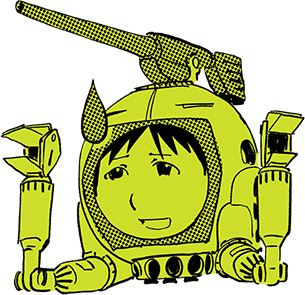
Luckily, the Gundam fortune-telling chart was also online at one point, and it’s been archived by the Internet Archive. As long as you know your astrological sign and your blood type, you too can figure out your own designation. Who knows—maybe you’ll match your favorite member of the Genshiken!
Well… phew. That was a lot longer than I thought it was going to be—and it took a lot longer, too. Here’s to hoping that future chapters will be less dense, and that I’ll see you around for more Rebuild of Genshiken soon.
Ja né!